Online B.Tech for Working Professionals in India: WILP Explained (2026 Guide)
Research partner: College Vidya | Data sources: AICTE, UGC, BITS Pilani WILP, DTU, Wipro
You are a diploma holder. You already have a job. Now you want a B.Tech, but you can’t afford to quit. Is that possible?
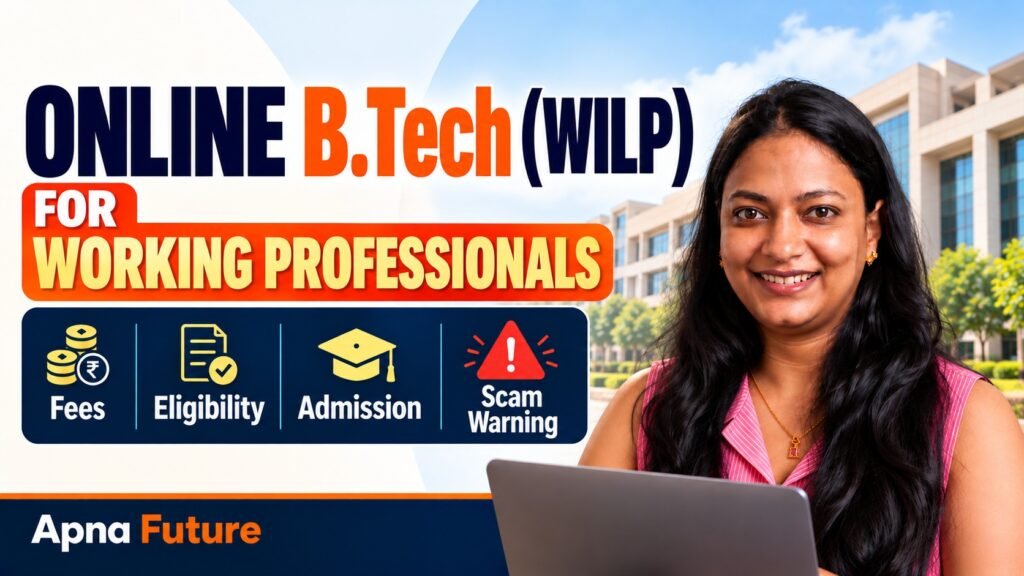
It is, with a catch. Under AICTE and UGC norms, a 100% online B.Tech is not treated as a valid degree. The legitimate route is the Work Integrated Learning Programme (WILP), usually called Online B.Tech for working professionals. It is a hybrid format: live online classes, but physical exams and labs.
This guide is based on our conversation with College Vidya’s Career Development Advisors, plus a check of AICTE’s circulars and official university pages. It covers who is eligible, who is not, what the degree is worth on your resume, the two routes (company-sponsored and self-sponsored), 9 checks before you pay, and how to avoid “100% online B.Tech” scams.
Pro tip: If you are considering an online degree, book your 1:1 free counselling session to clear all your doubts
What Is WILP (Work Integrated Learning Programme)?
WILP is an umbrella term for degrees where your job and your studies run in parallel. Classes happen on weekends or after office hours. You can pursue B.Tech, M.Tech, MBA and M.Sc this way.
Diploma holders get lateral entry into the 2nd year, so most programs take roughly 3 to 3.5 years instead of 4.
This isn’t a new idea. BITS Pilani has been running WILP since 1979, so it has about 46 years of track record. Many other universities now offer it too, but their eligibility rules differ.
How AICTE regulates it
AICTE issued structured guidelines for B.Tech for working professionals in 2023 and revised them in 2024. The key point: AICTE says classes under this scheme must be face-to-face (physical mode) for the degree to be valid. That is why a program that is “100% online” with no physical component should raise a red flag.
Who Is Eligible for an Online B.Tech (WILP)?
Under the AICTE framework, you are generally eligible if:
- You are employed in a registered company (private or PSU) located within 75 km of the institute
- You have at least 1 year of work experience
- You hold a 3-year engineering diploma (polytechnic), which gets you into the 2nd year. Some programs also admit BSc and BCA graduates.
So the program is mainly for two kinds of people:
- Diploma holders who want a B.Tech while working
- Working engineers or technicians who have hands-on experience but never completed a B.Tech degree
| You’re likely eligible | You may struggle | |
|---|---|---|
| Diploma | Relevant engineering diploma | Non-engineering diploma |
| Marks | Above the university cut-off (e.g., 60% at BITS and DTU) | Below the cut-off |
| Job | Employed, in a role related to the B.Tech branch | Job unrelated to the branch |
| Experience | As the program requires (e.g., 6 months to 2 years at BITS depending on the program, 1 year at Galgotias, 2 years at DTU) | Less than the minimum |
| Location | Employer within 75 km of the institute (where the program applies this rule) | Employer too far away |
Is It Worth It? Career Benefits and Resume Value
Honest answer: yes, but it isn’t a magic wand. Here is where it actually helps:
- It clears the HR screen. Many job descriptions say “B.Tech/BE required.” Without the degree, your resume may never get shortlisted, however good your skills are.
- It formalises your experience. Three to five years of work now sits next to a recognised qualification, which matters for promotions, grade, pay band and designation in many companies.
- It opens doors beyond the job. M.Tech admissions, some government/PSU recruitments and moving abroad can need a B.Tech, but the rules differ everywhere. Read the official notification of your target job or exam.
- You get a network. Your classmates are other working professionals.
The university name also matters. A name like BITS Pilani carries more weight on a resume. In interviews, say it plainly: “I did a work-integrated program alongside my job.” Employers often read that as discipline.
Two Routes: Corporate-Sponsored vs Self-Sponsored WILP
| Corporate-Sponsored WILP | Self-Sponsored WILP | |
|---|---|---|
| How you join | Your company enrols you in its partner university’s program | You apply directly to the university |
| Who pays | Usually the company | You pay |
| Catch | Often a service agreement/bond | Needs employer NOC or employment letter |
| Risk | Low | Depends on the university you choose, so due diligence matters |
| Examples | Wipro, Tata Motors (Saksham, Lakshya), Cummins India | BITS Pilani, Galgotias, DTU and others |
Wipro WILP: how the company-sponsored route works
Wipro is the best-known example, and “Wipro WILP” is a popular search. Wipro’s Work Integrated Learning Programme runs several tracks, and Wipro’s own WILP impact report describes WASE (Wipro Academy of Software Excellence) and WIMS (Wipro Infrastructure Management School), along with an M.Tech option from BITS Pilani.
For diploma holders, the relevant track is SIM (School for IT Infrastructure Management):
| Wipro SIM | |
|---|---|
| Who it’s for | Diploma holders in CS, IT, Electronics, Telecom, Electrical & Electronics and related branches |
| What you get | Full-time job at Wipro (Scholar Trainee) plus a Wipro-sponsored B.Tech in Information Systems from an Institute of Eminence |
| Eligibility (as listed) | 10th and 12th pass, minimum 50% in diploma, specific graduation years per hiring cycle |
| Stipend (as listed) | Rises each year, from about ₹12,400/month in year 1 to about ₹19,600/month in year 4 |
| Selection | Online assessment, voice assessment, technical and HR interviews |
| Apply via | Wipro’s SIM page on Superset |
Before you join any company-sponsored WILP, ask HR these 5 questions
- Will the company pay the complete fee or only part of it?
- How much salary or stipend will you get during the course?
- Is there a service agreement or bond, and for how long?
- What happens to your degree if you leave the company midway?
- Who pays the remaining fees or bond amount if you leave?
Self-Sponsored Route: BITS Pilani WILP and Other Universities
If your company doesn’t run a program, you can apply directly. Expect universities to ask for an employer NOC or employment letter, so talk to your HR/manager first. Also plan leave for exams and labs.
BITS Pilani WILP (the benchmark)
BITS Pilani WILP offers B.Tech degrees in eight areas, not just one. All are 7-semester programs, and BITS’s WILP programs are UGC-approved. To see the current list on BITS’s site, go to Programmes Offered → B.Tech.
| B.Tech program (WILP) | Qualification accepted | Min. marks | Work experience | Total fee |
|---|---|---|---|---|
| Engineering Technology | Technical Diploma or BSc (with Maths) | 60% | 6 months, relevant | ₹5,21,900 |
| Smart Manufacturing | Technical Diploma or BSc (with Maths) | 60% | 6 months, relevant | ₹5,21,900 |
| Process Engineering | Technical Diploma or BSc (with Maths) | 60% | 6 months, relevant | ₹5,21,900 |
| Power Engineering | Technical Diploma or BSc (with Maths) | 60% | 6 months, relevant | ₹5,21,900 |
| Artificial Intelligence & Machine Learning | Technical Diploma or BSc (with Maths) | 60% | 6 months, relevant | ₹5,34,500 |
| Electronics Engineering | Diploma in Electronics, Electrical, Electronics & Communication, Instrumentation, Mechatronics or a related domain, or BSc with Maths | 60% | 1 year | ₹5,21,900 |
| Engineering Design | Technical Diploma or BSc | 60% | 2 years | ₹5,21,900 |
| Civil & Infrastructure Engineering | Technical Diploma (Civil, Mechanical or Electrical) with adequate engineering preparation | 60% | 2 years, in construction-related domains | ₹5,21,900 |
What’s common across the BITS B.Tech programs:
| Feature | Details |
|---|---|
| Fee breakup | Sem 1: ₹91,700 (application ₹1,500 + admission ₹18,500 + semester fee ₹71,700). Sems 2–7: ₹71,700 each. For AI & ML: Sem 1 ₹93,500, then ₹73,500 per semester. 0% EMI is available. |
| Classes | About 32 hours of live weekend instruction per course (roughly 7–8 hrs/week), plus recordings |
| Exams | Quizzes and assignments online. Mid-sem and comprehensive exams are in person at designated centres across India. |
| Mentor | You must nominate a mentor, ideally your supervisor. BITS doesn’t assign one. |
| Campus visit | Optional Campus Immersion Programme, not mandatory |
| Placements | No traditional campus placements, since you’re already employed |
Other universities offering B.Tech for working professionals
| University | Class mode | Official Fees | Source Status |
|---|---|---|---|
| BITS Pilani | Live online + virtual labs; in-person exams | ₹5,21,900 total (₹5,34,500 for AI & ML) | Official program page |
| Galgotias University | Weekends | Lateral-entry track with a 1-year work-experience condition: ₹90,000 tuition + ₹20,000 exam fee per year, plus ₹650/yr medical and ₹3,000 one-time charges. ≈ ₹3.35 lakh over 3 years (our calculation). | Official fee page |
| Sanskriti University | Evenings/weekends | ₹42,500 course fee + ₹3,000 exam fee per semester, plus ₹3,000 one-time registration. ≈ ₹2.76 lakh over 6 semesters (our calculation). Scholarship up to ₹63,750 (July 2026 session only). | Official fee page |
| Mangalayatan University | Weekend and evening classes, virtual labs | ₹40,000/sem + ₹1,000 exam fee/sem for Civil, CSE, EE, ECE and ME. ≈ ₹2.46 lakh over 6 semesters. CSE with AI-ML, Data Science or Cyber Security is ₹41,000 + ₹1,000/sem (≈ ₹2.52 lakh). | Official WILP site |
| Delhi Technological University (DTU) | Evening classes, 6 days a week | ₹6,30,800 over 4 years (₹1,56,700 + ₹1,55,700 + ₹1,55,700 + ₹1,62,700), plus ₹1,500 registration | Official 2026–27 brochure |
| Symbiosis Skills & Professional University | 70% on-the-job / 30% theory | N/A | N/A |
| Graphic Era University | Working-professional B.Tech in Civil, ECE and Mechanical (3 years) | N/A | N/A |
| IEC University, HP | Live + recorded classes, virtual labs | N/A | N/A |
| Amity University | Part-time (Automobile Engineering) | N/A | N/A |
Symbiosis Skills & Professional University is built around a skill-based model: 70% skill component done on the job, 30% theory. It is ranked #1 in the NIRF Skill University category in 2025 (second year running), which makes it a good fit for core fields like Mechanical or Automobile.
Graphic Era University lists working-professional B.Tech programs in Civil, Electronics & Communication and Mechanical Engineering, each 3 years, with admission on merit of the qualifying exam.
Delhi Technological University (DTU) runs a 4-year evening B.Tech under Continuing Education for Working Professionals, with classes six days a week from 6 to 9 pm (some on Sundays). For 2026–27:
- Branches: Civil, Electrical, Electronics & Communication, Mechanical (60 seats each). Branch availability can change from year to year.
- Eligibility: a relevant 3-year diploma with at least 60% for the general category, and at least 2 years of experience after the diploma.
- Employer location: your employer must be in Delhi NCT or within 75 km of DTU.
- Selection: merit based on diploma marks.
- Employer NOC: mandatory, on company letterhead. It includes a commitment that you’ll stay with the organisation for the duration of the course.
How the admission process typically works
- Register on the university’s admission portal.
- Fill in education and work details.
- Upload documents, including employer NOC and experience letter.
- Pay the application fee and submit.
- The admission cell reviews it and usually responds in 2–3 weeks.
Scam Warning: “100% Online B.Tech, Zero Attendance”
Search “Can I do B.Tech while working?” and you’ll see ads claiming “100% Online B.Tech: Study From Home, Zero Attendance.” Don’t trust them.
- You may also see ads for an “IGNOU online B.Tech.” IGNOU did offer B.Tech through distance mode, but it was discontinued, because UGC held that technical education can’t be delivered in distance mode.
- The Supreme Court and AICTE gave relief only to learners already enrolled up to 2011–12. Any “IGNOU online B.Tech” after that is not valid.
9 Checks Before You Enrol in an Online B.Tech (Save This)
| # | Check | What to verify |
|---|---|---|
| 1 | AICTE approval | Check the current year’s AICTE Working Professionals approvals page for your college and program. You need an Extension of Approval (EoA) under the Working Professionals scheme, and last year’s approval doesn’t carry over. |
| 2 | UGC recognition | On the UGC portal: click the HEIs dropdown → choose the university category → search your university’s name. It must be recognised under UGC Act Section 2(f). |
| 3 | Admission and eligibility | Is your diploma branch relevant? Is your score above the cut-off (e.g., 60% at BITS and DTU)? How much experience is needed? Does your job match the branch? Ask for the NOC/experience letter format. |
| 4 | Fees | Get a full breakup: application, admission, semester, exam and lab fees. Ask how it’s paid semester-wise and what extra you pay for backlogs or extensions. |
| 5 | Duration | Most programs run 3 to 4 years. Know the rules on extensions and backlogs if work gets heavy. |
| 6 | Delivery mode and schedule | Are classes live or recorded? Do timings clash with your job? How many days per semester must you be physically present for exams and labs? |
| 7 | Distance from your employer and exam centres | AICTE’s revised 2024 guidelines require the employer to be within 75 km of the institute. UGC-recognised universities may have their own exam centre and lab rules, so ask. |
| 8 | Placement support | Most programs don’t run placement drives because you’re already employed. If a university advertises placement support, ask what it actually delivers. |
| 9 | Career progression | Will the degree be accepted for your target: promotion, government/PSU jobs, GATE/M.Tech or abroad? Read the official notification and confirm with the university. |
“BITS Pilani and Amity aren’t on the AICTE list. Are they not approved?”
They are fine. UGC-recognised universities don’t need separate AICTE approval for their own degree programs. The AICTE approval requirement applies mainly to affiliated colleges. BITS Pilani holds UGC’s Institute of Eminence status, and Amity is a private university established under a state act.
Learner Experiences: What Do Working Professionals Say?
Learners on Reddit repeatedly mention three things: tight assignment deadlines, some one-sided classes, and the difficulty of taking leave for offline exams. Many also say the degree is tough but rewarding for their career. Overall, reviews are mixed.
Cost and ROI: Quit Your Job or Study While Working?
Scenario: you earn ₹30,000/month and weigh a 3-year lateral-entry B.Tech.
| Quit and study full-time | WILP while working | |
|---|---|---|
| Lost salary (36 months × ₹30,000, no increments) | ₹10.8 lakh | ₹0 (you keep earning) |
| Tuition (and living expenses for regular college) | ₹6–8 lakh | ₹2.5–6.5 lakh depending on university (company may sponsor) |
| Total cost | About ₹17–19 lakh | About ₹2.5–6.5 lakh |
| Experience | 3 years lost | +3 years gained |
That is a difference of roughly ₹11–16 lakh, plus three years of experience.
Will a self-sponsored ₹5 lakh degree pay back?
According to some surveys, people report:
- 15–20% salary hikes with a promotion or senior role at the same company
- 30–50% jumps when switching jobs with a B.Tech plus ~3 years of experience
These figures vary by case and are not guaranteed.
Final Verdict
- If you have a diploma and 1–5 years of experience, don’t quit. Study alongside your job.
- Corporate-sponsored WILP carries the least risk. Just read the bond terms.
- For self-sponsored WILP, confirm AICTE and UGC compliance, check industry acceptance, and don’t fall for 100% online degree scams.
Reminder: If you are considering an online degree, you can book 1:1 free counselling session at no cost to clear all your doubts
Frequently Asked Questions
Kya 100% online B.Tech valid hai?
No. AICTE’s working-professionals framework expects physical, face-to-face classes. Programs with no attendance, labs or proctored exams are a red flag.
Diploma ke baad job karte hue B.Tech kaise karein?
Join a WILP (Work Integrated Learning Programme). With a relevant diploma and the required experience, you enter the 2nd year through lateral entry and finish in about 3 to 4 years, depending on the university.
BITS Pilani WILP mein B.Tech ke kaun se programs hain?
BITS Pilani WILP offers B.Tech in Engineering Technology, Smart Manufacturing, Process Engineering, Power Engineering, Artificial Intelligence & Machine Learning, Electronics Engineering, Engineering Design, and Civil & Infrastructure Engineering. All are 7 semesters. Not every program opens in every intake, so check BITS’s current list.
BITS Pilani WILP ke liye eligibility kya hai?
A technical diploma or BSc (with Maths) with at least 60% marks, and current employment. Required experience ranges from 6 months to 2 years depending on the program. Check the program page for the current criteria.
Employer college se kitni door hona chahiye?
Under AICTE’s revised 2024 guidelines, the employer should be located within 75 km of the institute. Some UGC-recognised universities set their own rules, so confirm with the university.
Wipro WILP kya hai, aur kya iske liye eligible hone ke liye Wipro mein job honi chahiye?
Wipro WILP is a set of company-sponsored programs (SIM, WIMS, WASE). Candidates are selected through Wipro’s hiring process, and Wipro sponsors the degree. You join Wipro as an employee, so it isn’t a program you can enrol in from another employer.
Kya IGNOU online B.Tech karwata hai?
No. IGNOU’s B.Tech through distance mode was discontinued, and relief was given only to learners enrolled up to 2011–12.
Online B.Tech degree ke baad kya salary badhegi?
Surveys report 15–20% hikes with in-company promotion and 30–50% on switching jobs, but this varies and is not guaranteed.
Disclaimer: This article reflects publicly available information as of October 2026. Fees, eligibility and approvals change, so confirm with the university and the AICTE/UGC websites before applying.

Sarvesh is the Founder of Internshala, India’s leading early talent development platform that has helped millions of students and early-career professionals land their first opportunity. With over a 15 years of building at the intersection of education and employment, Sarvesh has been at the forefront of shaping how India’s next generation enters the workforce and shares his insights and knowledge through this blog. All his free time is either spent playing with his twin boys or watching whatever is trending on OTT platforms.